
Dual Control Model of Sexual Desire: The Raw Science

Let's be brutally honest: your sexual desire isn't some mystical force that just "happens." It's not magic, and it's not random. Your arousal is governed by two competing neurological systems—one that accelerates your desire, and one that hits the emergency brake. Understanding this is the difference between a mediocre sex life and one that's genuinely explosive.
Welcome to the dual control model of sexual desire—the groundbreaking framework that explains why you're horny at some moments and completely turned off at others, even when your partner is doing everything "right."
This isn't pop psychology. This is peer-reviewed neuroscience, developed by leading sex researchers, and it's about to transform how you think about your bedroom life.
What Is the Dual Control Model?

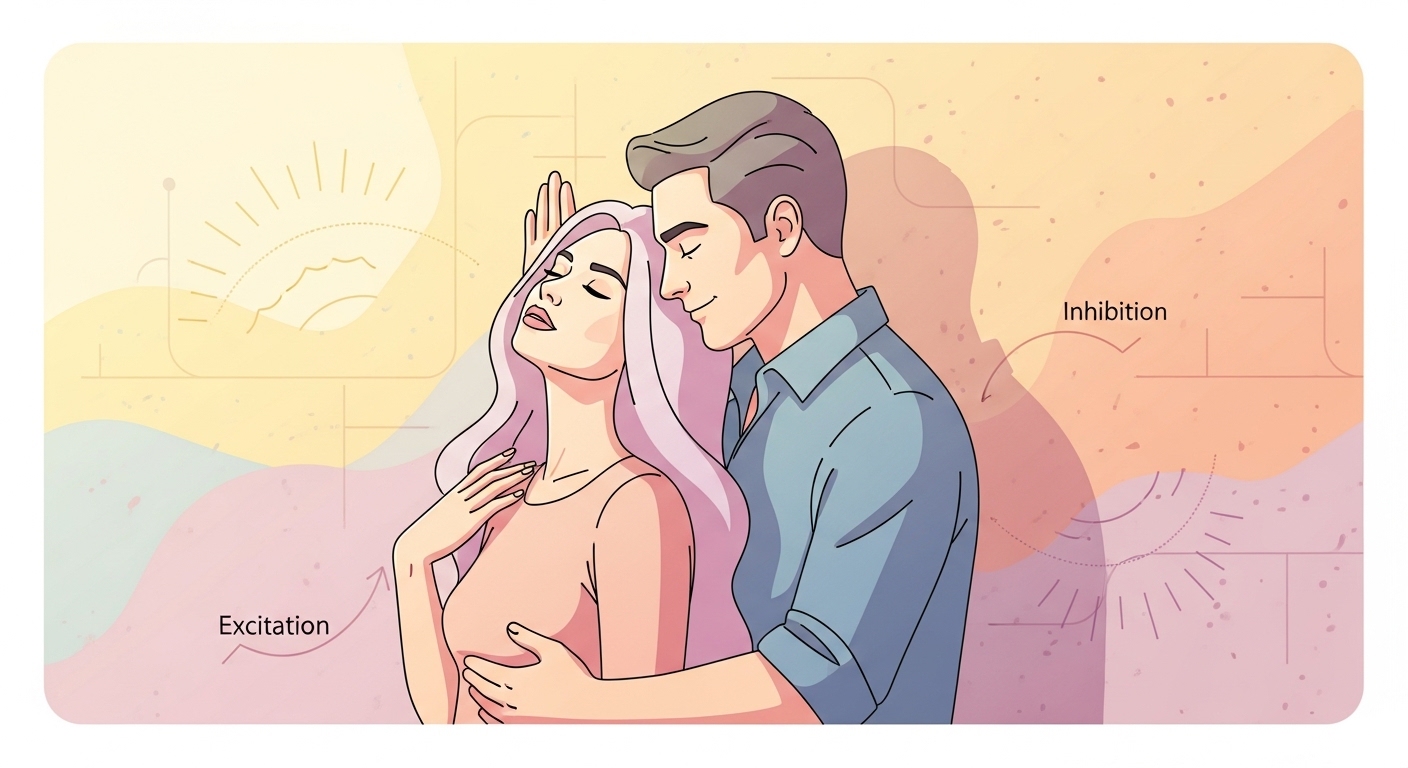
The dual control model, pioneered by sex researcher Erick Janssen and colleagues at the Kinsey Institute, proposes that sexual response is controlled by two independent neurological systems:
-
Sexual Excitation System (SES): This is your accelerator. It detects sexually relevant stimuli—a touch, a look, a thought, a smell—and cranks up your arousal. People with high SES are more easily turned on by a wider range of triggers.
-
Sexual Inhibition System (SIS): This is your brake. It detects potential threats, distractions, or reasons not to be aroused—performance anxiety, relationship conflict, work stress, body image concerns, or even just the sound of kids in the next room. People with high SIS are more easily turned off by these inhibitory cues.
Here's the crucial insight: these two systems operate independently. You can have a high excitation system AND a high inhibition system. Or low on both. Or any combination. And your unique ratio determines your sexual personality.
The Four Sexual Personality Types
When you map these two systems against each other, you get four distinct sexual profiles. Knowing yours—and your partner's—is like having the cheat code to your intimate life.
Type 1: High Excitation, Low Inhibition ("The Accelerator")
These people are easy to turn on and hard to turn off. They're aroused by a wide range of stimuli, they don't overthink sex, and they recover quickly from distractions. They're often the ones initiating, experimenting, and generally bringing high sexual energy to the relationship. If this is you, you might feel frustrated with a partner who needs more "warming up."
Type 2: Low Excitation, High Inhibition ("The Brake Master")
These people need specific, ideal conditions to become aroused. They're easily distracted, prone to performance anxiety, and sensitive to relationship tension. They might feel "broken" or "not sexy enough," but they're not—they just have a more selective arousal system. This type often struggles with desire discrepancy in relationships and might benefit from understanding that their inhibition system is simply more reactive.
Type 3: High Excitation, High Inhibition ("The Complex Lover")
This is the person who can be incredibly passionate one moment and completely shut down the next. They have strong sexual desire but also strong sexual anxiety. They might be turned on by intensity but also triggered by it. They need both freedom and safety—a paradox that can feel confusing to navigate.
Type 4: Low Excitation, Low Inhibition ("The Steady Partner")
These people have moderate sexual interest and aren't easily distracted, but they also aren't easily ignited. They're the steady, reliable partners who enjoy sex when it happens but don't necessarily crave it. They might have lower spontaneous desire but can still enjoy partnered sex with the right conditions.
Why Your Excitation System Matters More Than You Think

Here's where it gets interesting: your sexual excitation system is highly individual. What triggers arousal for your partner might do absolutely nothing for you. And that's not a flaw—it's just neurology.
Research shows that people with high sexual excitation systems tend to:
-
Be aroused by a wider range of sexual stimuli (visual, auditory, tactile, contextual)
-
Have more spontaneous sexual desire
-
Experience more intense orgasms
-
Be more adventurous in the bedroom
-
Recover faster after sex
But here's the trap: having a high SES doesn't automatically mean better sex. If your inhibition system is also firing—if you're anxious, distracted, or disconnected from your partner—that arousal gets blocked at the gate.
This is why feeling more connected during intimacy is so critical. Emotional safety directly suppresses your inhibition system, allowing your excitation system to do its job.
The Inhibition System: Your Arousal's Biggest Enemy (And Why It Exists)
Your sexual inhibition system isn't a bug—it's a feature. It evolved to protect you. It keeps you from having sex in dangerous situations, with unsafe partners, or when you're not emotionally ready. It's survival instinct.
But in modern relationships, this system often misfires. Common inhibitory triggers include:
-
Performance Anxiety: The fear that you won't be "good enough" literally shuts down arousal. Your brain prioritizes survival over pleasure.
-
Relationship Conflict: Unresolved tension, resentment, or disconnection activates your threat-detection system. You can't get wet or hard when you're subconsciously defending against your partner.
-
Body Image Concerns: Shame about your body directly inhibits arousal. You're too busy hiding to feel pleasure.
-
Distraction and Mental Load: Work stress, financial worry, parenting responsibilities—these keep your brain in "threat mode" rather than "pleasure mode."
-
Lack of Novelty: Repetitive, predictable sex can trigger boredom, which activates inhibition. Your brain literally loses interest.
-
Negative Past Experiences: Trauma, shame, or past rejection can create a hypervigilant inhibition system that's always scanning for danger.
The profound insight here is this: you can't think your way out of inhibition. You have to address the underlying threat. That's why communication, vulnerability, and emotional safety are non-negotiable for good sex.
Wondering how to rebuild that safety with your partner? Emotional intimacy questions every couple should ask are designed to crack through the surface-level stuff and get to the real blocks. Want more questions like this? Download PairPlay: Couple Relationship App and get hundreds of conversation starters designed to deepen trust and dismantle inhibition.
How to Optimize Your Excitation System and Minimize Inhibition
Now that you understand the science, here's how to actually use it.
For High Excitation Types
Your challenge isn't turning on—it's making sure your partner can keep up. Focus on:
-
Novelty and Variety: Introduce new scenarios, positions, toys, or fantasies regularly. Your brain craves stimulation.
-
Explicit Communication: Don't assume your partner knows what turns you on. Tell them. Show them. Be specific.
-
Playfulness: High excitation types often thrive on sexual play and banter. Use humor and flirtation to keep things fresh.
-
Patience with Your Partner's Inhibition: If your partner has a high inhibition system, understand that they need more time, safety, and reassurance to match your energy. This isn't rejection—it's neurology.
For High Inhibition Types
Your challenge is creating the safety and conditions where arousal can flourish. Focus on:
-
Eliminate Distractions: Lock the door. Turn off your phone. Create a physical and mental space where you're not scanning for threats.
-
Build Anticipation: Inhibition systems respond well to structure. Plan sex. Anticipate it. Your brain will start priming arousal in advance.
-
Address Relationship Tension: If there's conflict or disconnection, address it directly before trying to have sex. Your inhibition system won't let you relax until you feel safe.
-
Reframe Performance Pressure: Sex isn't a performance. It's not about orgasms or duration or looking a certain way. When you release that pressure, your inhibition system quiets down.
-
Explore What Actually Turns You On: Don't rely on what "should" turn you on. Experiment. Notice what genuinely sparks interest. Your inhibition system is less reactive when arousal is authentic.
This is exactly where PairPlay turns these concepts into a fun game. The app guides couples through discovery questions about their sexual preferences, desires, and boundaries—all in a playful, judgment-free format. No performance pressure. Just honest exploration.
The Dual Control Model and Desire Discrepancy
One of the most common relationship complaints is desire mismatch: one partner wants sex more than the other. Now you understand why this happens at a neurological level.
If one partner is high excitation/low inhibition and the other is low excitation/high inhibition, you've got a structural mismatch. The first partner's brain is literally wired to want sex more often and more easily. The second partner's brain is wired to want it less often and only under specific conditions.
This isn't about love. It's not about attraction. It's neurology. And once you both understand this, the shame and resentment can start to dissolve.
The solution isn't for the high-desire partner to "just accept it" or for the low-desire partner to "just do it more." The solution is understanding each other's actual wiring and finding creative compromises. Maybe that means scheduled sex (which helps the high-inhibition partner anticipate and prepare). Maybe it means more foreplay or different types of touch. Maybe it means exploring fantasies that genuinely excite the lower-desire partner.
Want to have this conversation without it turning into an argument? The 21-day relationship challenge to reconnect provides a structured framework for couples to explore desire, preferences, and fantasies together in a safe, playful way. It's designed specifically to bridge desire gaps and rebuild sexual connection.
Foreplay, Desire, and the Dual Control Model

Here's a truth that changes everything: foreplay isn't just physical touch. It's neurological preparation.
For high-excitation types, foreplay might be brief—a few touches and they're ready. But for high-inhibition types, foreplay is the entire process of gradually quieting the brake system and activating the accelerator system. It's not just about stimulation; it's about building safety, anticipation, and focus.
Foreplay is about connection, not just physical touch—and this is where the dual control model becomes crystal clear. The emotional connection, the reassurance, the presence of your partner—these are what actually shift your partner's neurological state from inhibited to excited.
If you're struggling to understand what your partner actually needs during foreplay, PairPlay helps couples communicate their specific desires through guided questions and scenarios. No guessing. No assumptions. Just clarity.
Building Your Personalized Sexual Blueprint
Understanding the dual control model is step one. Applying it to your specific relationship is step two.
Start here:
-
Identify Your Types: Reflect honestly on whether you're high or low on excitation and inhibition. How easily do you get aroused? How easily are you turned off? Be specific.
-
Map Your Partner's Profile: Without judgment, consider where your partner falls. What genuinely turns them on? What consistently kills their arousal?
-
Identify Your Mismatches: Where do your profiles conflict? Where do they align?
-
Create Conditions for Both: If you're high-excitation, create novelty and intensity. If your partner is high-inhibition, create safety and predictability. Find the overlap.
-
Communicate Explicitly: Stop hinting. Stop hoping your partner figures it out. Tell them what actually turns you on. Ask them what turns them on. Listen without defensiveness.
This is the work that transforms a mediocre sex life into an extraordinary one. And it starts with understanding your own neurology.
Conclusion: Your Sexual Desire Is Not Broken
If you've ever felt like something was wrong with your sexual desire—that you want sex too much or not enough, that you're easily distracted, that you have conflicting impulses—now you know: you're not broken. You're operating according to your neurological wiring.
The dual control model gives you a framework to understand yourself and your partner without shame. High excitation isn't "too much." High inhibition isn't "frigid." They're just different systems, and they all have value.
The couples who build extraordinary sex lives aren't the ones with perfectly matched desire. They're the ones who understand their own wiring, understand their partner's wiring, and get curious about bridging the gap.
That curiosity—that willingness to explore, communicate, and experiment—is where real sexual connection lives.
Ready to go deeper? Living together for the first time brings its own unique challenges to sexual intimacy and desire. And for couples at any stage looking to strengthen their sexual and emotional connection, download PairPlay: Couple Relationship App today. It's built specifically to help couples navigate desire, fantasy, boundaries, and connection through guided conversations and playful games. No judgment. No performance pressure. Just real intimacy.
Keep the conversation going.
Download PairPlay for thousands more questions, games, and guided conversations designed to deepen intimacy, unlock desire, and strengthen your connection.
Related reading
Frequently Asked Questions
Can your sexual excitation and inhibition types change over time?
Yes. Your types can shift based on life circumstances, relationship quality, health, stress levels, and even age. Someone might be high-excitation in their 20s and shift to high-inhibition during a stressful career phase or after relationship trauma. The model isn't fixed—it's responsive to your current state. This is actually hopeful: if your desire has changed, understanding the dual control model helps you identify what's actually driving that shift.
Is the dual control model the same for men and women?
The basic framework applies to all genders, but research suggests some interesting differences in how the systems operate. Women, on average, tend to have higher sexual inhibition systems (more easily turned off by threat cues), while men tend to have higher sexual excitation systems. But individual variation is huge—some women are high-excitation/low-inhibition, and some men are the opposite. Don't use the model to make gender assumptions; use it to understand your specific partner.
What if my partner and I have completely opposite sexual types?
This is actually very common and completely workable. The key is understanding that your differences aren't incompatibilities—they're just different neurological wiring. The high-excitation partner needs to appreciate that their partner's inhibition system is protective, not rejecting. The high-inhibition partner needs to appreciate that their partner's excitation system is natural, not demanding. From there, you find creative solutions: scheduled sex, more elaborate foreplay, novelty, reassurance, whatever bridges the gap for both of you.
Can you train yourself to have higher sexual excitation or lower sexual inhibition?
Partially. You can't rewire your baseline neurology, but you can create conditions that optimize your system. For high-inhibition types, reducing stress, building relationship safety, and eliminating distractions all help. For low-excitation types, exploring new fantasies, novelty, and explicit communication can increase arousal. Think of it like fitness: you can't change your body type, but you can optimize what you have.
How do I know if my low sexual desire is about the dual control model or about deeper relationship issues?
Often it's both. If your inhibition system is consistently activated, that's usually a sign that something feels unsafe—emotionally, physically, or psychologically. This could be relationship conflict, unresolved hurt, lack of emotional connection, or past trauma. The dual control model explains the mechanism, but addressing the underlying issue requires deeper work: honest conversation, possibly therapy, and rebuilding trust. That's where tools like PairPlay can help—they create a structured, safe space for couples to address what's actually driving desire issues.
Written by PairPlay Editors
The PairPlay editorial team brings you the best research, tips, and stories to help craft deeper, stronger, and more exciting relationships.
Explore more topics
Keep building topical authority with deep dives by theme.
Keep The Spark Alive Daily
Install PairPlay and turn tonight into your best date night yet.
Get instant access to couple games, spicy prompts, and quick connection rituals built for real life. Open the app, pick a challenge, and reconnect in minutes.